

Mold Remediation in Grand Rapids, MI: The Complete Homeowner’s Guide
Table of Contents
Finding a dark, fuzzy patch in your basement or smelling that unmistakable musty odor in your Grand Rapids office is enough to make any property owner’s heart sink. Whether you’re managing a historic storefront downtown or a family home in East Grand Rapids, the discovery of mold feels like a violation of your safety and your investment. At RAM Restoration, we understand the stress of the unknown, wondering if your indoor air quality is compromised or if the structure of your building is at risk. This guide is designed to strip away the confusion, providing you with a clear, professional roadmap for mold remediation in Grand Rapids so you can reclaim your property and your peace of mind.
What is Mold Remediation?
Mold remediation is the professional process of identifying, containing, removing, and preventing mold growth, following IICRC S520 and EPA guidelines and differs from mold removal in that it addresses the underlying moisture source. While “removal” simply cleans the visible spots, remediation ensures the environment is no longer hospitable for spores to return.
How do I know if I need mold remediation in Grand Rapids?
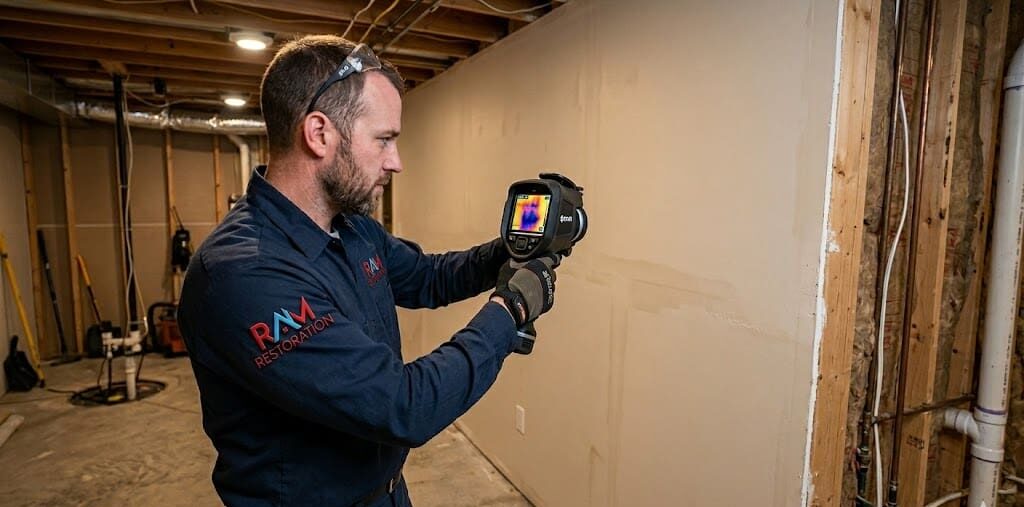
If you can see visible growth larger than 10 square feet, or if there is a persistent musty odor following a basement flood, professional remediation is necessary. Because West Michigan experiences high humidity and damp winters, localized moisture often hides behind drywall or under floorboards, requiring thermal imaging to detect.
The Difference Between Mold Removal and Professional Remediation
Many homeowners search for mold removal in Grand Rapids, thinking it’s a simple one-step cleaning process. However, mold is a biological organism; if you spray bleach on the surface but leave the roots in the porous wood or the humidity in the air, it will return.
Professional remediation involves a comprehensive seek and destroy mission. By adhering to the IICRC S520 standard, we ensure that the mold is not just gone, but that the Grand Rapids indoor air quality is restored to a healthy baseline.
The Role of a Mold Inspection in Kent County
Before any scrubbing begins, a professional mold inspection in Kent County is vital. This process often involves:
- Air Sampling: Comparing indoor spore counts to the outdoor Michigan air.
- Surface Testing: Identifying the specific species, such as Stachybotrys chartarum (black mold).
- Moisture Mapping: Using moisture meters to find the leak that started it all.
Is black mold removal in Grand Rapids different from other types?
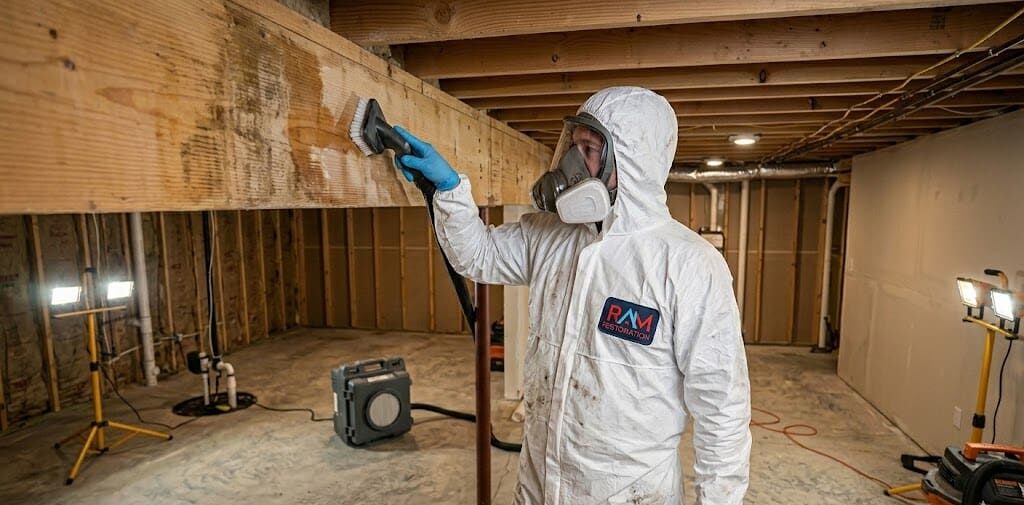
Yes, black mold removal in Grand Rapids requires more stringent containment measures because certain species produce mycotoxins that are hazardous when inhaled. Professionals use HEPA-filtered air scrubbers and negative pressure zones to ensure that while the mold is being agitated and removed, it does not spread to the rest of the building.
The RAM Restoration Remediation Process
Our approach to mold remediation in Grand Rapids is methodical and transparent. We don’t just clean; we restore.
1. Source Identification and Water Damage Repair
Mold is a symptom of a water problem. If you’ve recently suffered a pipe burst or roof leak, you must first address the water damage restoration needs of the property. Without fixing the leak, remediation is a temporary fix.
2. Containment and Air Filtration
We seal off the affected area with heavy-duty plastic sheeting. We use industrial EPA-approved air scrubbers to capture microscopic spores that become airborne during the cleaning process.
3. Professional Removal and Sanitization
Our team performs certified mold remediation in Grand Rapids by physically removing contaminated porous materials (like drywall or insulation) and cleaning non-porous surfaces with antimicrobial treatments.
How much does mold remediation cost in West Michigan?
The cost of mold remediation in Grand Rapids typically ranges from $1,500 to $5,000 for standard residential projects, though large-scale commercial or structural issues can be higher. Pricing depends on the size of the affected area, the accessibility of the mold (e.g., in a crawlspace vs. a bedroom), and the extent of the necessary demolition.
Health Risks and Regulatory Guidelines
The CDC mold health risks documentation notes that mold exposure can lead to respiratory issues, especially in children and the elderly. The Michigan Dept. of Health and Human Services emphasizes that while some mold is natural, indoor levels must be controlled to prevent long-term health complications.
We follow guidelines set by NORMI (National Organization of Remediators and Mold Inspectors) to ensure that every project we complete meets or exceeds national safety standards for Grand Rapids indoor air quality.
Professional Mold Remediation in Grand Rapids: Contact RAM Restoration
Don’t let a mold problem linger and threaten your health or your property value. RAM Restoration is your local expert in mold remediation in Grand Rapids and throughout Kent County. As an IICRC certified firm, we have the specialized equipment and training to handle everything from minor attic growth to extensive black mold removal in Grand Rapids.
We are available 24/7 for emergency water and mold situations, ensuring that you never have to face a property crisis alone.
Take the first step toward a cleaner, safer home today.
- Call Now: (616) 818-1700
- Request a Free Assessment: Link to Contact Form
- Visit Us: Serving all of Grand Rapids and the surrounding West Michigan communities.
Available 24/7/365 | IICRC Certified | (616) 818-1700 | Contact Us Online | Google Business Profile
Frequently Asked Questions
Can I stay in my house during mold remediation?
In most cases, you can stay in your home if the mold is confined to a specific area like a basement or attic that can be completely sealed off. However, if the HVAC system is contaminated or the remediation covers multiple rooms, professionals may recommend temporary relocation to avoid exposure to spores and cleaning agents.
Does homeowners insurance cover mold?
Insurance coverage for mold usually depends on the cause of the moisture. If the mold resulted from a “sudden and accidental” event, like a water heater bursting, it is often covered. If the mold grew due to long-term neglect or high humidity, coverage might be denied.
How long does the remediation process take?
A typical mold remediation in Grand Rapids project takes between 3 to 7 days. This includes the initial inspection, setting up containment, the actual cleaning/removal, and the final “drying out” period to ensure moisture levels are below the threshold for new growth.
