


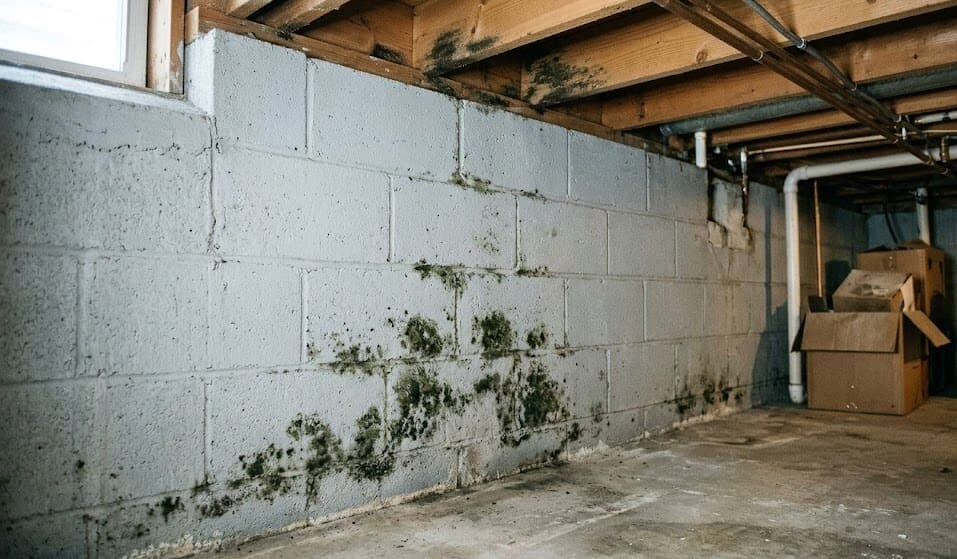
Mold in Your Grand Rapids Basement or Crawl Space: Causes, Signs & Solutions
If you’re buying a home in Grand Rapids and the inspection report flagged moisture or discolouration in the basement, you’re probably feeling anxious and rightfully so. Basement mold removal in Grand Rapids is one of the most common issues we encounter as restoration professionals, and it’s a topic every buyer and current homeowner in Kent County needs to understand. The good news? When caught early and handled correctly, basement and crawl space mold is very treatable.
This post walks you through exactly why mold takes hold below grade, the warning signs you should never ignore, and what professional remediation actually looks like so you can move forward with confidence.
Table of Contents
Basement mold in Grand Rapids is primarily caused by elevated humidity, poor ventilation, and water intrusion, conditions worsened by Michigan’s clay-heavy soils and hydrostatic pressure. The EPA recommends keeping indoor humidity below 60% (ideally 30–50%) to prevent mold growth. In Grand Rapids basements, common culprits include condensation on cold walls, leaking window wells, sump pump failure, and unencapsulated crawl spaces that absorb ground moisture. These are the most common signs of mold in a Grand Rapids basement:
- Visible dark spots or fuzzy growth on walls, joists, or insulation
- Persistent musty or earthy odour, especially noticeable after rain
- Peeling paint, bubbling drywall, or white chalky efflorescence on concrete
- Allergy or asthma symptoms that worsen indoors
- Condensation on basement windows or pipes
- Visible water stains, rust streaks, or efflorescence on block walls
- Warped wood framing, subfloor, or trim near the foundation
Why Grand Rapids Basements Are Especially Vulnerable to Mold
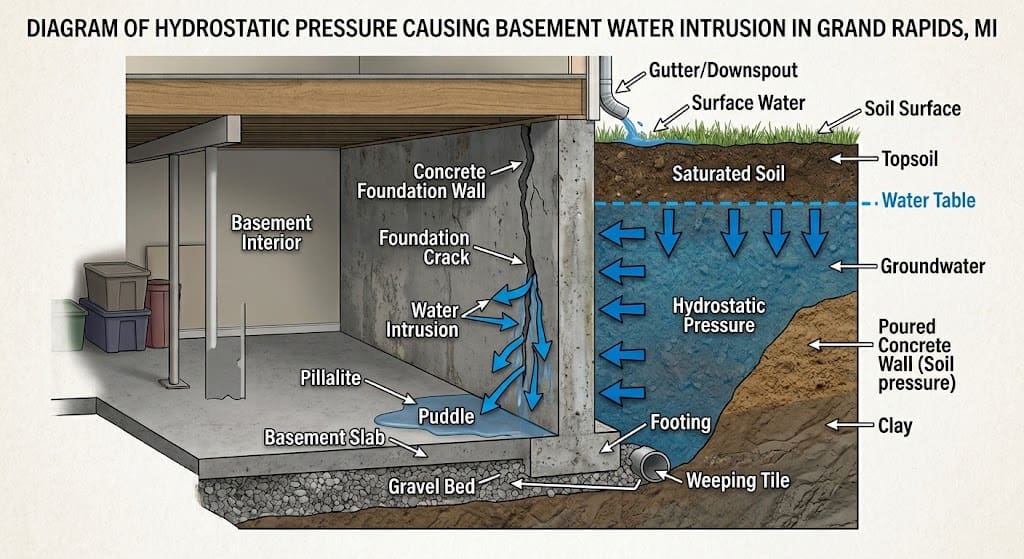
Grand Rapids sits on a mix of clay and loam soils that retain water far more effectively than sandy ground. After heavy rainfall or spring snowmelt, that moisture creates hydrostatic pressure against your foundation walls, slowly pushing water vapour or actual water into your basement. Combined with Michigan’s humidity swings (averaging 70–80% outdoor relative humidity in summer), it doesn’t take much for the conditions below your floor to become a mold incubator.
Michigan’s Climate and Your Foundation
Kent County experiences freeze-thaw cycles every winter that expand and contract concrete and block foundations. Over time, hairline cracks develop and water finds a way in. Even a foundation that appears solid can be allowing vapour migration, which is invisible but equally damaging when it condenses on cold interior surfaces.
Crawl Spaces: The Forgotten Moisture Trap
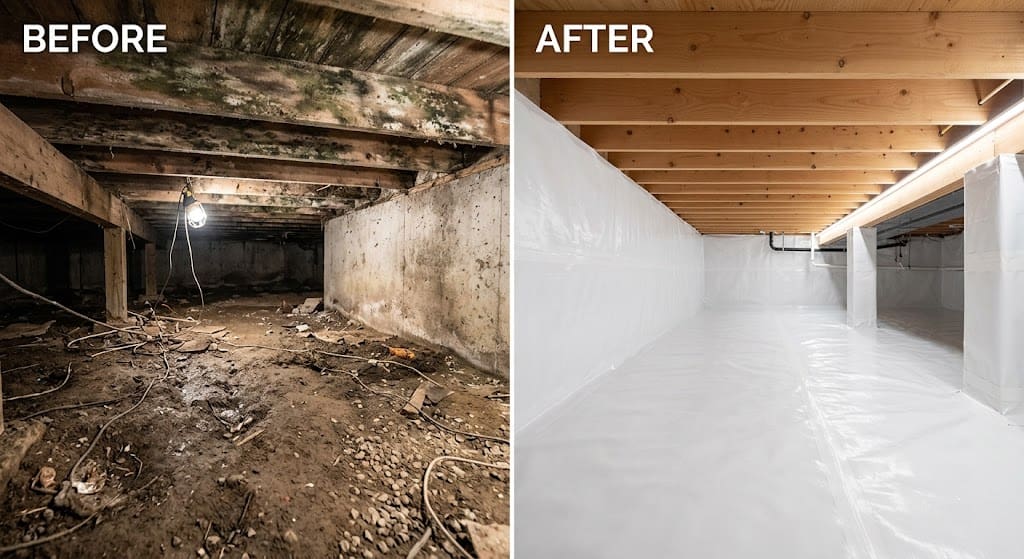
If your Grand Rapids home has a crawl space, the risk is even higher. Without a proper vapor barrier or encapsulation system, ground moisture evaporates directly into the crawl space air and that air rises into your living spaces. The IICRC S520 standard for mold remediation specifically identifies crawl spaces as high-priority moisture zones. Exposed soil, wood joists resting close to the ground, and poor ventilation create the perfect storm for mold growth that can quietly spread for months before you notice it.
Related: For a broader look at mold in your home, see our complete resource — Mold Remediation in Grand Rapids, MI: The Complete Homeowner’s Guide.
What Does Basement Mold Look Like? (And What to Smell For)
Mold in a basement doesn’t always look like the dramatic black patches you see in photos. In early stages it can be white, grey, or green, sometimes appearing as a powdery film on concrete or a fuzzy coating on wood. Here’s a breakdown of what to look for:
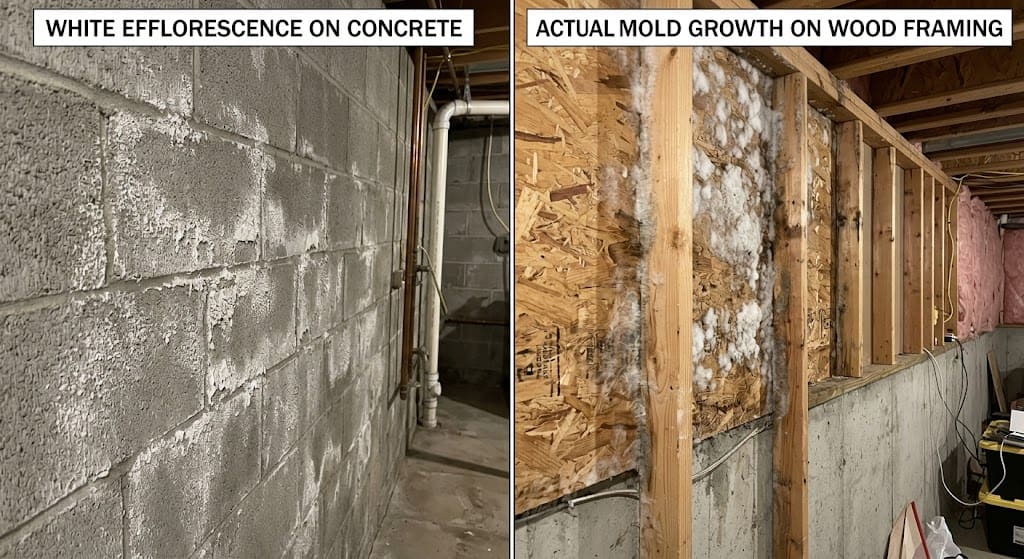
Mold vs. Efflorescence — Know the Difference
Efflorescence is the white crystalline deposit left behind when water moves through concrete and evaporates, leaving mineral salts on the surface. It’s not mold, but it IS a sign of moisture intrusion, which is the condition mold needs. If you’re seeing white powder on your basement walls, take it seriously as an early warning signal.
Smell as a Diagnostic Tool
A musty, earthy, or damp smell in your basement even if you can’t see anything is one of the most reliable indicators that mold is present somewhere. Mold often grows behind drywall, inside insulation batt, or under carpet padding. If the smell is noticeably stronger after rain or when the HVAC runs, that’s a strong diagnostic flag for active mold growth.
What Is the Main Cause of Mold in a Basement?
The primary cause of basement mold is sustained moisture whether from water intrusion, condensation, or high ambient humidity. In Grand Rapids homes, this is most often driven by hydrostatic pressure from clay-heavy soil, inadequate grading around the foundation, or failed waterproofing. The EPA’s basement moisture guidelines recommend a combination of interior drainage, vapour barriers, and dehumidification to control moisture at the source. Addressing the moisture source is always step one; treating visible mold without fixing the underlying cause will result in regrowth.
How Do I Know If Mold in My Basement Is Dangerous?
All mold should be taken seriously, but certain species including Stachybotrys chartarum (black mold), produce mycotoxins that can cause respiratory symptoms, headaches, and immune reactions. If basement mold is dark greenish-black with a slimy texture, or if household members are experiencing persistent symptoms (coughing, congestion, fatigue), have the mold professionally tested. IICRC-certified remediators can take surface or air samples to identify species and concentration levels.
Can Basement Mold Spread to the Rest of My House?
Yes and faster than most homeowners expect. HVAC systems, air circulation, and even foot traffic can distribute mold spores from the basement to upper levels. Once spores land on organic material (wood, drywall paper, carpet) in conditions above 60% humidity, new colonies can establish within 24–48 hours. This is why early intervention matters: containment and remediation of a localised basement problem is far less disruptive and costly than treating a whole-house spread.
Is Crawl Space Mold Different From Basement Mold?
The species are often the same, but the conditions in a crawl space are usually more severe. Crawl spaces have less airflow, sit closer to soil moisture, and often have exposed wood that mold can colonise quickly. Encapsulation sealing the crawl space with a heavy-duty vapour barrier meeting IICRC S520 standards is the most effective long-term solution. In some cases, crawl space mold can compromise the structural integrity of floor joists, making professional assessment important if mold is found in this area.
Basement Humidity and Mold Growth: The Numbers That Matter
Mold needs three things: a food source (any organic material), oxygen, and moisture. The one variable you can actually control is moisture. Here are the thresholds that matter for Grand Rapids homeowners:
- Below 50% RH: Mold cannot establish or sustain growth
- 50–60% RH: Elevated risk, monitor and dehumidify
- Above 60% RH: Active mold growth likely within days on organic surfaces
- Michigan basement humidity averages in summer: 65–75% without mechanical dehumidification
- EPA guideline: Keep indoor humidity at 30–50% year-round
A properly sized dehumidifier with a drain line (not a bucket you have to empty) is one of the best investments you can make in a Grand Rapids basement. Pair it with a digital hygrometer to monitor levels continuously.
The Role of Ventilation
Many older Grand Rapids homes have basement windows that are painted shut or permanently blocked. Improving cross-ventilation even just ensuring your dryer vent exhausts outside and your HVAC return isn’t pulling air directly from the basement can meaningfully reduce humidity buildup. Crawl space venting strategy has changed significantly; current building science generally favours sealed, conditioned crawl spaces over passively vented ones, particularly in Michigan’s climate.
Does Basement Mold Always Come From Water Damage?
Not always but water damage is one of the fastest triggers. A flooded basement in Grand Rapids that isn’t completely dried within 24–48 hours will almost certainly develop mold. And if a previous water event was dried without professional moisture mapping, mold may already be established inside walls or under flooring even if the surface feels dry.
Similarly, mold after water damage is extremely common because the moisture trapped inside structural materials (drywall, insulation, subfloor) is not visible to the naked eye. Thermal imaging and moisture meters are the only reliable way to confirm dryness after a water event which is exactly the protocol RAM Restoration follows on every job.
Can I Remove Basement Mold Myself?
For very small, isolated mold patches (under 10 square feet) on non-porous surfaces like concrete, limited DIY treatment with EPA-registered antifungal products and proper PPE (N95 respirator, gloves, eye protection) may be appropriate. However, the EPA and IICRC recommend professional remediation when:
- The affected area is larger than 10 square feet
- Mold is on porous materials (drywall, insulation, wood framing, carpet)
- There is a known or suspected moisture source that hasn’t been resolved
- Household members have respiratory conditions, allergies, or compromised immunity
- You cannot identify the moisture source
- Mold has returned after a previous DIY treatment
Improper DIY removal especially anything that aerosolizes mold spores without containment can spread contamination to previously clean areas of your home. IICRC S520-compliant remediation uses negative air pressure, physical containment barriers, HEPA filtration, and controlled demolition to prevent cross-contamination.
Basement Mold Removal in Grand Rapids? RAM Restoration Is Ready 24/7
IICRC-Certified | Serving Grand Rapids & Kent County | 24/7 Emergency Response Call Now or Request Your Free Mold Assessment
RAM Restoration has been protecting Grand Rapids and Kent County homes from mold, moisture damage, and water intrusion for years. Our IICRC-certified technicians follow the IICRC S520 standard on every mold remediation, meaning proper containment, air filtration, safe removal, and thorough post-remediation verification before we call a job complete.
We offer:
- Free on-site basement and crawl space mold assessments
- IICRC S520-compliant remediation for all mold types
- Moisture mapping with thermal imaging and professional-grade meters
- Crawl space encapsulation and vapour barrier installation
- Insurance documentation and claims support
- 24/7 emergency response because water damage doesn’t work 9 to 5
Whether you’re buying a home, dealing with a recent flood, or you’ve just noticed something growing in the corner of your basement, don’t wait. Early action is the difference between a minor treatment and a major remediation. Visit our complete Grand Rapids mold remediation guide to understand your options, or contact RAM Restoration today.
Call us 24/7 at (616) 818-1700 | Request a free assessment at ramrestoremi.com| Serving Kent County and Greater Grand Rapids
Frequently Asked Questions About Basement Mold in Grand Rapids
How long does basement mold remediation take?
Most residential basement mold remediation in Grand Rapids takes between 1–3 days for a contained area. Larger infestations involving multiple rooms or structural materials can take up to a week. Timing depends on scope, the extent of demolition required, and drying time after treatment.
How much does basement mold removal cost in Grand Rapids?
Costs vary based on the size of the affected area, materials involved, and moisture source. Minor remediation (under 10 sq ft, non-porous surfaces) may cost $500–$1,500. Moderate to severe infestations involving drywall and insulation removal typically range from $2,000–$6,000 or more. RAM Restoration provides free on-site assessments so you get an accurate scope before committing.
Will homeowner’s insurance cover basement mold removal?
Coverage depends on the cause. Mold resulting from a sudden, covered water loss (burst pipe, appliance failure) is often covered. Mold from long-term seepage, flooding, or deferred maintenance is typically excluded. Your RAM Restoration team can document the cause of loss and provide the detailed reports insurers require
Is black mold always in the basement?
No, Stachybotrys chartarum (commonly called black mold) can grow anywhere with prolonged moisture, including bathrooms, kitchens, and around HVAC systems. Basements and crawl spaces are high-risk areas because of ground moisture and limited airflow, but black mold can and does appear above grade.
How do I prevent mold from coming back after remediation?
Long-term prevention requires resolving the moisture source not just treating the mold. Depending on your home, this may include foundation waterproofing, crawl space encapsulation with a proper vapour barrier, installation of a drainage mat or French drain, mechanical dehumidification, and improved exterior grading to direct water away from the foundation. RAM Restoration can advise on the right combination for your specific Kent County home.
Available 24/7/365 | IICRC Certified | (616) 818-1700 | Contact Us Online | Google Business Profile
